
A Focused Content Communications Approach for Large Organizations

The communications landscape has fundamentally shifted, creating a growing need for organizations to integrate earned, owned and paid content.
For large organizations and universities, the days of relying solely on traditional media relations channels are receding. As the nature of legacy media changes, its power to cut through the noise is diminishing. The ability to deploy a strong owned content strategy (which also leverages earned approaches) and a thoughtful marketing approach are crucial for big organizations that are used to pumping out lots of media releases.
Many large organizations already run smart, strategic marketing and communications campaigns. But for complex, often decentralized structures like universities or large, matrixed corporations, the real challenge lies in finding a way to focus the efforts of dozens, if not hundreds, of communicators spread across different departments and units.
Coherence and focus are vital if you want to be heard, particularly if you want to leverage those decentralized channels to present a clear message. Determining your focus is critical to setting direction as a senior communications leader, because there’s only so much money and time to spend telling stories. Hard choices have to be made.
Here’s how you can think about determining that focus and then deploying it.
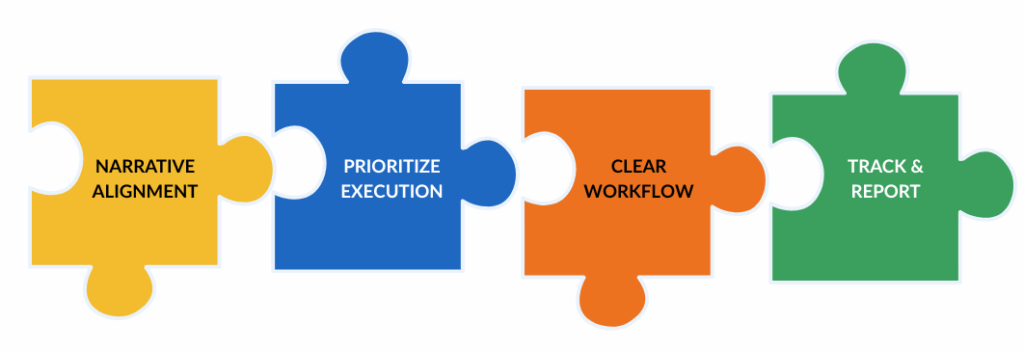
Establish Narrative Alignment from the Top Down
The first, and perhaps most crucial, step is to align your communications efforts with your organization’s broad narrative and strategic goals.
Ideally, you already have a bedrock document—a strategic plan or business plan—that has been worked through and approved by your executive leadership. This plan, coming from your CEO or president, is your foundation. Once you have this, you can build a comprehensive strategic communications plan (with core narrative and messaging) directly rooted in that core strategy.
This plan provides an organization-wide focus for all communications. It also creates a mechanism for engagement and input so other folks can better understand the central focus and provide insight on where there might be overlap. Finally, it helps align stories, releases and social media posts, no matter where they originate, toward a broader focused mission. Ultimately, this unity is a critical prerequisite for broader communication success.
Prioritize Execution Over Endless Planning
Once you’ve achieved alignment and built out your core messaging and narrative, the next piece of work is to define a clear timeline and approach that does not attempt to “boil the ocean”.
It’s tempting for large organizations to spend months or even years developing an overwhelmingly complex communications or marketing strategy. But in our experience, this can be counterproductive, sacrificing the “good enough” for the unattainable “perfect”. Trying things, failing, iterating and trying again is much more effective for building a robust and focused content engine.
It’s also better at helping you get a handful of quick wins early on. Find focused stories that can score immediate points on the board. Get those successes under your belt, then use that momentum to build alignment and further execution in tandem with your central communications drive. Start small, show value, then strategically scale up.
Develop a Clear and Focused Workflow
The third component for a highly focused communications approach is developing a clear workflow. This workflow must be designed to pull in the diverse communications, stories and content pieces flowing from your decentralized organization.
It’s like panning for gold: You need a system to sift through the content to find the most aligned (though perhaps not necessarily the most newsy) pieces to promote and then work to apply a unified narrative layer. Because stories coming from different areas will naturally have different framing, angles and styles, it’s paramount to bake in a clear narrative and focus through the editing and approval process.
Once this content is refined and aligned, you can then tactically deploy it across various channels: social media platforms, enterprise channels, internal communications, external op-ed pitching or paid campaigns. The workflow is the machine that creates coherence from chaos.
The Final Step: Tracking and Reporting
Finally, once your system is set up—your stories are aligned, your focus is clear, your workflows are built and your deployment strategy is in place—it is crucial to track it all.
To fully understand your impact, consider using purpose-built software and systems that allow you to track your content and link it directly to your key themes or campaign focuses. This allows for a consistent and structured reporting approach. You could use a custom tool built specifically for communications, issues and media relations teams (like Broadsight), or adapt generic software.
The key is that some form of rigorous tracking is essential. When you track, make sure you are thoughtfully considering all the different ways you are communicating, doing so in a way that is insightful but not overly time-consuming. This ongoing data collection is what will allow you to constantly refine your focus and ensure your communications are truly cutting through the clutter.
Broadsight makes it easy to connect the dots between earned media and all the work your team does behind the scenes. To see how, ask for a free personalized tour today.
Receive our newsletter
Sign up below and we’ll be in touch with monthly updates about Broadsight, along with news and insights to keep you on the cutting edge of communications work in an AI era.
